by Numan Shaikh | Oct 30, 2025
No they will not.
The Cornet ED88T is a combination meter designed to measure ambient AC electric fields, AC magnetic fields, and radio frequency (RF) fields. This meter is NOT effective for measuring dirty electricity. Here are a few reasons why…
- The frequency range covered by this meter does not cover all dirty electricity frequencies.
- The meter is not sensitive enough on the lower end to register levels of dirty electricity considered “too high” by experts in the field.
- The meter is unable to distinguish between the 60 Hz electric and magnetic fields from standard AC electricity and the higher frequency electric and magnetic fields associated with dirty electricity.
To measure dirty electricity, you need an oscilloscope or plug-in EMI meter.
An oscilloscope and spectrum analyzer provide the best way to analyze specific characteristics of the dirty electricity present on building wires. Unfortunately, these tools can be quite expensive and require significant expertise and experience to use effectively.
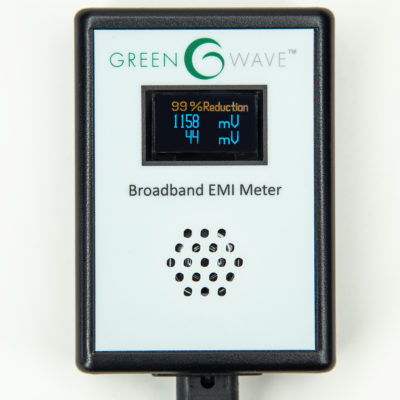
A much easier and cost-effective way to measure dirty electricity on building circuits is to use a plug-in EMI (electromagnetic interference) meter, also known as a line noise meter or microsurge meter. Two examples of such meters are the Greenwave Broadband EMI Meter and the Stetzerizer Microsurge Meter. These meters are easy to use. Simply plug them into electrical outlets to find out how much dirty electricity is present on nearby wiring. These meters are also very useful for guiding the installation of dirty electricity filters for optimal results. They can help you determine the best number of filters to install in each room and which combination of electrical outlets to choose for installation.
The table below provides some basic information about the Greenwave and Stetzerizer meters.
| Frequency Range |
3 kHz – 10,000 kHz |
4 kHz – 100 kHz |
| Measurement Units |
Millivolts (mV) |
Graham-Stetzer (GS) Units |
Measurement Range
(Sensitivity) |
1 – 1999 mV |
1 – 2000 GS Units |
| Audio Feature |
YES
Let’s you listen to the dirty electricity (i.e., electrical noise) present on building wiring. |
NO |
| Other Special Features |
Makes gauging the effectiveness of dirty electricity filters easy.
- BEFORE filter and AFTER filter readings can be displayed on the same screen simultaneously.
- Display screen also shows % reduction in total EMI noise following filter installation.
|
N/A |
by Numan Shaikh | Oct 30, 2025
No they will not.
The Cornet ED88T is a combination meter designed to measure ambient AC electric fields, AC magnetic fields, and radio frequency (RF) fields. This meter is NOT effective for measuring dirty electricity. Here are a few reasons why…
- The frequency range covered by this meter does not cover all dirty electricity frequencies.
- The meter is not sensitive enough on the lower end to register levels of dirty electricity considered “too high” by experts in the field.
- The meter is unable to distinguish between the 60 Hz electric and magnetic fields from standard AC electricity and the higher frequency electric and magnetic fields associated with dirty electricity.
To measure dirty electricity, you need an oscilloscope or plug-in EMI meter.
An oscilloscope and spectrum analyzer provide the best way to analyze specific characteristics of the dirty electricity present on building wires. Unfortunately, these tools can be quite expensive and require significant expertise and experience to use effectively.
A much easier and cost-effective way to measure dirty electricity on building circuits is to use a plug-in EMI (electromagnetic interference) meter, also known as a line noise meter or microsurge meter. Two examples of such meters are the Greenwave Broadband EMI Meter and the Stetzerizer Microsurge Meter. These meters are easy to use. Simply plug them into electrical outlets to find out how much dirty electricity is present on nearby wiring. These meters are also very useful for guiding the installation of dirty electricity filters for optimal results. They can help you determine the best number of filters to install in each room and which combination of electrical outlets to choose for installation.
The table below provides some basic information about the Greenwave and Stetzerizer meters.
| Frequency Range |
3 kHz – 10,000 kHz |
4 kHz – 100 kHz |
| Measurement Units |
Millivolts (mV) |
Graham-Stetzer (GS) Units |
Measurement Range
(Sensitivity) |
1 – 1999 mV |
1 – 2000 GS Units |
| Audio Feature |
YES
Let’s you listen to the dirty electricity (i.e., electrical noise) present on building wiring. |
NO |
| Other Special Features |
Makes gauging the effectiveness of dirty electricity filters easy.
- BEFORE filter and AFTER filter readings can be displayed on the same screen simultaneously.
- Display screen also shows % reduction in total EMI noise following filter installation.
|
N/A |
by Numan Shaikh | Oct 30, 2025
No they will not.
Greenwave filters target ONE type of EMF pollution in homes and other buildings: DIRTY ELECTRICITY. They do not reduce power frequency AC electric and magnetic fields or wireless radiation.
As background, there are 4 types of EMF pollution – i.e., artificial electromagnetic fields (radiation) – common in homes and other buildings today. These different types of EMF pollution require different kinds of meters for measurement and often different remediation strategies. Here is a brief summary of the 4 types of EMF pollution.
WIRELESS RADIATION
Wireless radiation refers to the electromagnetic fields/radiation (EMF/EMR) created by devices and infrastructure that send information (e.g., voice, video, data,…) from one place to another through the air rather than via wires or cables. This type of EMF pollution is also called radio frequency (RF) radiation and microwave radiation and is nearly everywhere these days.
Common sources of wireless radiation include cordless phones, cell phones, cell towers/antennas, WiFi (wireless Internet), laptops, tablets, video game systems, smart watches and other wearable technologies, smart utility meters, wireless baby monitors, wireless security systems, GPS, airport radar, police and fire broadcast towers, radio and television broadcast towers, and much more!
To measure wireless radiation, you need a radio frequency (RF) meter or a combination meter with an RF setting.
LEARN MORE about Wireless Radiation and how to reduce your exposure
(link to wireless radiation page on website)
POWER FREQUENCY AC ELECTRIC FIELDS
Power frequency AC electric fields refer to the extremely low frequency (ELF) electric fields emitted by items that distribute and use conventional 60 Hertz, 120 Volt AC electricity. These fields are produced by VOLTAGE, which is the force or pressure ready to push electrical current through power lines, wires (circuits), cords, etc. AC electric fields are present even when electrical current is NOT flowing. For example, a lamp cord that is plugged into an outlet will emit an electric field even when the lamp is turned off. The field will go away only after the lamp is unplugged.
Common sources of AC electric fields include power lines, electrical wiring (circuits), power cords and strips, and appliances and other devices than run on electricity.
To measure AC electric fields, you need an electric field strength meter, a body voltage meter, or a combination meter with an AC electric field setting.
LEARN MORE about AC Electric Fields and how to reduce your exposure
(link to AC electric fields page on website)
POWER FREQUENCY AC MAGNETIC FIELDS
Power frequency AC magnetic fields refer to the extremely low frequency (ELF) magnetic fields emitted by items that distribute and use conventional 60 Hertz, 120 Volt AC electricity. These fields are produced by the FLOW of electrical current. Unlike AC electric fields, magnetic fields are present only when electrical current is acutally flowing. For example: A hair dryer that is plugged into an outlet and turned ON will emit both AC magnetic and electric fields. When the hair dryer is switched OFF, current flow to the dryer stops, and the AC magnetic fields goes away. The AC electric field, which is produced by voltage rather than current flow, will remain until the hair dryer is unplugged from the outlet.
Common sources of AC magnetic fields include power lines, electricity substations and transformers, electric meters, circuit breaker panels, electric appliances/tools/devices with motors or transformers, old knob and tube wiring, wiring errors in branch circuits (e.g., improper neutral-to-neutral and neutral-to-ground connections), and current on grounding paths such as metal water pipes, the sheathing for cable TV lines, etc.
To measure AC magnetic fields, you need a gauss meter or a combination meter with an AC magnetic field setting.
LEARN MORE about AC Magnetic Fields and how to reduce your exposure
(link to AC magnetic fields page on website)
DIRTY ELECTRICITY
Dirty electricity is created by modern electronics and other electrical devices that must change or manipulate conventional 60 Hertz, 120 Volt AC electricity in one way or another in order to operate. These changes and manipulations create surges and spikes of electromagnetic energy (i.e., harmonics and voltage transients) that travel along building wires where only conventional (“clean”) AC electricity should be. Once created, dirty electricity can travel throughout a building and from one building to another via wiring, power lines, and other means. It radiates EMF pollution approximately 6 feet into rooms as it travels.
Common sources of dirty electricity include light dimmer switches, compact fluorescent light bulbs (CFLs), fluorescent tubes, LED light bulbs, energy efficient appliances, solar panel inverters, smart meters, chargers for cell phones and other devices, and most consumer electronics (for example: computers, printers, TVs, video game systems, and much more).
To measure dirty electricity effectively, you need an oscilloscope and spectrum analyzer or a plug-in EMI meter, also known as a line noise meter or microsurge meter.
- An oscilloscope and spectrum analyzer provide the best way to analyze specific characteristics of the dirty electricity present on building wires. Unfortunately, these tools can be quite expensive and require significant expertise and experience to use effectively.
- A plug-in EMI meter, such as Greenwave Broadband EMI meter, provides a much easier and cost-effective way for most people to measure the level of dirty electricity on building circuits. This type of meter is easy to use. Simply plug it into electrical outlets to find out how much dirty electricity is present on nearby wiring. Plug-in EMI meters are also very useful for guiding the installation of dirty electricity filters for optimal results. They can help you determine the best number of filters to install in each room and which combination of electrical outlets to choose for installation.
Dirty electricity is the one type of EMF pollution that can be effective filtered. Greenwave filters are designed to significantly reduce the level of dirty electricity present on the wiring in buildings. The less dirty electricity there is traveling along building wires, the less that will radiate into rooms where people spend time. As mentioned previously, Greenwave filters target dirty electricity. They do NOT get rid of power frequency AC electric and magnetic fields or wireless radiation.
LEARN MORE about Dirty Electricity and how to reduce your exposure.
by Numan Shaikh | Oct 30, 2025
The goal is to get the number below 50. Sometimes, for a variety of reasons, that’s not always possible.
There is a point where adding filters only goes so far. Most homes, however, can achieve the optimal numbers with 2 – 3 filters per room. The Greenwave Meter helps greatly with understanding where to place the filters.
by Numan Shaikh | Oct 30, 2025
Heres a link to the comparison of our filters and Stetzers. – https://greenwavefilters.com/greenwave-filters-versus-stetzerizer-filters/
We typically outperform Stetzer Filters side by side using the Stetzer meter for measurement by about 5 – 15%.
Greenwave filters are grounded and have a 3 prong (grounded) outlet on the bottom so you don’t lose the outlet.
Greenwave filters are RoHS certified. (no toxic materials or heavy metals in the filter). Stetzers are not.
Greenwave filters cover a wider range of frequencies.
Greenwave filters are manufactured by AstrodyneTDI, a US company.\
We hired expert EMI/EMF engineers to design the filters.